Category: Gaming

  • The House Edge – CFTC vs. Michigan on Prediction Market regulations

    The House Edge – CFTC vs. Michigan on Prediction Market regulations

    What the house knows. Occasionally.

    Issue #07 | July 19, 2026

    THE LEAD

    More regulatory conflict this week, and a new kind. The CFTC ordered Kalshi to keep its Michigan trades open after a Michigan judge ordered them cancelled, so a federal regulator and a state court are now giving the same company opposite orders. MGM confirmed the Diller talks are real: the board formed a special committee and JPMorgan is helping him raise the money. And Macau analysts cut their 2026 forecasts across the board just as the World Cup ended today. Earnings season starts July 22 with expectations finally low.

    THE BOOK

    US iGaming, Sports Betting & Prediction Markets

    The CFTC tells Kalshi to ignore a state court

    Background first. A Michigan judge ordered Kalshi to stop taking Michigan trades and unwind the ones it already took. Kalshi asked the CFTC for permission to comply: it filed an emergency rule to suspend Michigan access and close out Michigan positions.

    On July 14 the CFTC said no. It blocked Kalshi’s rule and ordered the company to honor every executed trade. Chairman Michael Selig said canceling executed trades “risks a cascading effect on the entire marketplace,” and that a state cannot force a federally regulated exchange to break its federal obligations.

    The judge did not back down. She extended the ban through August 12 and set the penalty: geofence Michigan by the end of that day or pay $120,000, rising to $500,000 per day. Kalshi says it is “reviewing” the order. It has no clean option left: obey the judge and defy the CFTC, or obey the CFTC and rack up state fines.

    The rest of the board

    FrontStatusNext date
    MichiganTRO extended; CFTC ordered Kalshi to keep the trades alive anywayGeofence deadline Aug 12 ($500K/day after)
    New YorkKalshi appealed its preemption loss to the 2nd Circuit the same dayEmergency relief seen as a long shot
    9th Circuit (Nevada)Ruling expected around July 15 never landedAny day
    Nevada (state court)Contempt hearing was set for July 16; no ruling reported by press time. The state supreme court separately refused to pause the geofencing mandateContempt decision pending
    ConnecticutJudge barred Kalshi from citing the CFTC’s own league partnerships as preemption evidenceCase proceeds
    4th Circuit (Maryland)Ruling pendingExpected by July 30
    WisconsinAGA moved to intervene in CFTC v. Wisconsin, on the state’s sideMotion pending
    ArizonaSecretary of State banned election-related prediction trading outrightIn effect

    Washington stirs

    • The House Agriculture subcommittee holds a hearing July 21 on customer protections and market integrity in sports event contracts.
    • Rep. Dina Titus called the contracts “disguised financial derivatives” in a Hill op-ed. Another House bill would require facial-recognition age checks for bettors and prediction users.
    • The tribes escalated: three California tribes asked the 9th Circuit to force Kalshi off reservation land (one judge said the contracts “sound like a bet”), the Five Civilized Tribes demanded federal oversight, and CNIGA’s James Siva called prediction markets “without a doubt” the biggest threat to tribal gaming.

    If you can’t beat them

    • DraftKings won approval as a futures commission merchant. It can now run its prediction business in 48 states, with sports contracts live in 18.
    • Robinhood now routes event contracts through Rothera, an exchange it co-owns, and keeps all the economics instead of sharing with Kalshi. Event contracts pushed Robinhood’s “other transaction revenue” to $147M in Q1, up 320% from a year ago.

    The same industry fighting prediction markets in court is building its own. Whatever the judges decide, the incumbents want to own the rails.

    Volume keeps growing anyway. June was the biggest month prediction markets have ever had: Kalshi did $31.5B, and the two platforms combined did $44.8B, up 75% from May. Kalshi’s $95.7B in 1H26 is already four times its entire 2025. The World Cup drove $7.4B on Kalshi before the group stage even ended. About 85% of Kalshi’s June trading was sports, and sports was roughly two thirds of Polymarket’s Q1 volume.

    Month (2026)KalshiPolymarketCombinedYoY
    January$9.6B$7.7B$17.2B~8x
    February$9.9B$7.9B$17.9B~9x
    March$13.1B$10.6B$23.7B~11x
    April$14.8B$9.0B$23.8B~11x
    May$16.8B$8.9B$25.7B~13x
    June$31.5B$13.3B$44.8B~23x

    Source: Taker notional volume at $1 per contract, per The Block and DeFi Rate. Polymarket includes its new US exchange from May ($1.8B May, $3.0B June). YoY is approximate: no consistent public monthly series exists for early 2025, when the platforms ran near $1B each per month (Kalshi’s entire 2025 was $23.8B, and combined volume was still under $5B a month as late as September 2025). Not comparable to sportsbook handle.

    The tournament reset the scale. Bloomberg’s puts prediction markets at 27% of sports bets during the World Cup.

    Color from the week

    • Michael Burry’s positions got detail: long Flutter and DraftKings, roughly 60/40. Analysts read it as a bet that states eventually tax prediction markets like sportsbooks.
    • DraftKings sued Philadelphia in federal court to stop the city’s probe into its promotions and VIP programs.
    • FanDuel put another $7.5M into the industry’s Win for America super PAC, taking its total to $27M. The trajectory is the point: the PAC raised $41M in Q1 (FanDuel and DraftKings gave $19.5M each per FEC filings), passed $48M by April as Bet365 joined, and had spent $20M+ on statehouse primaries in six states by spring, routed through state PACs with neutral names like American Conservatives Fund. BetMGM is the notable holdout.
    • A Pennsylvania commission recommended banning live in-game betting outright. Advisory only, but in-game is most of modern handle, and the idea is now in print in a top-three state.

    So what? Until this week the fight was companies versus states. Now the federal regulator is in open conflict with state courts, and only the Supreme Court or Congress can settle that. Watch August 12: if Kalshi geofences Michigan to avoid the fines, every state AG gets a template. If it obeys the CFTC instead, a state judge decides whether to hold a company reportedly valued between $40B in contempt.

    THE ORIENT

    Macau & Asia

    Analysts caught up to the demand story. CLSA cut 2026 growth to 2%, Jefferies to 5%, and JP Morgan sits 8-10% below consensus on Sands China and MGM going into earnings. Citi still expects July at MOP21.0B (down 5%), and its channel check shows daily GGR improving to MOP621M as the match schedule thinned.

    Where the softness sits. New DICJ data shows 2Q VIP baccarat fell 18.8% from 1Q (down 2.6% YoY) while mass rose 0.8% and slots grew 17%. Total GGR came in flat at MOP61.0B, the lowest quarter since 1Q25. The weakness is at the top end, which fits the money-flow scrutiny from last week’s issue: DICJ met all six concessionaires this week about illegal livestreaming used for proxy betting. 1H26 arrivals rose 9% to 20.9M, but June fell 3.1% y/y, and day-trippers (+15.3%) are growing far faster than overnight guests (+0.2%).

    Korea: the policy risk shows up. Seoul may raise the tourism levy on foreigner-only casinos from 10% of revenue to 15%, a KRW30-50B (US$20-35M) annual hit to the six biggest venues, including Paradise City, Walkerhill and Seven Luck. Jeju is exempt.

    Singapore joins the soft patch. JP Morgan models Marina Bay Sands 2Q EBITDA down 5% to US$727M, the first decline since the US$1B room upgrade started paying off, with 1H Singapore arrivals down 1.7%.

    MGM China positions for the Diller endgame. The parent-level news this week, per the WSJ: MGM’s board formed a special committee with advisers to evaluate People Inc.’s $48.30 offer, and JPMorgan is helping Diller line up financing.

    Brief items

    • Okada Manila’s 2Q EBITDA fell 71% as VIP hold halved. An ugly print for Universal Entertainment.
    • PAGCOR says it will decide by August whether to privatize its self-operated casinos.

    So what? Macau demand continues to be soft across the board with VIP down from 1Q. Earnings open July 22 with expectations already low; what Sands says about reinvestment and share matters more than the print.

    THE OLD WORLD

    Europe + Canada

    Suppliers: one up, one sideways

    • Playtech jumped 22% after raising full-year EBITDA guidance to at least €270M (consensus was €205-225M), powered by Hard Rock Digital.
    • Evolution settled the UK Gambling Commission’s black-market review for £4.75M and let its $85M Galaxy Gaming acquisition lapse. Q2 revenue fell 1.2%, though Europe grew sequentially for the first time in several quarters.

    Germany loosened, a first. Germany’s regulator raised online slot stake limits for the first time under the current treaty: €3 per spin, or €5 for players with a clean 90-day history, versus the old €1 cap, with mandatory behaviour tracking attached. Licensed channelisation sits in the mid-double-digits, so this is a regulator choosing to win players back with product rather than keep losing them to the black market.

    Prediction markets, Europe edition

    • The Czech Republic ordered internet providers to block Polymarket.
    • Italy blocked Polymarket a second time, putting its €19M Lazio shirt sponsorship at risk.
    • The Dutch regulator rejected Polymarket’s appeal against its gambling designation.
    • Gibraltar went the other way: Europe’s first dedicated prediction-market licensing framework took effect July 13.
    • Spain’s proceedings from last week’s issue: no new development.

    Canada. Alberta launched regulated iGaming on July 13 with 22 sites live on day one, Canada’s second open market after Ontario. Ontario’s gaming minister Stan Cho resigned over expense claims; Attorney General Doug Downey, an architect of the iGaming framework, takes over mid-review.

    So what? Germany handing licensed operators product back is the rare European regulatory tailwind, a direct revenue lever for German-licensed books (Tipico, bwin, Merkur) into 2H. And file the French thread: if online casino legalization lands, Banijay is pre-assembled for it, on FDJ’s home turf, and this week’s disclosures finally put numbers on what it is building.

    THE LOCAL

    US Regional Gaming & Deal Watch

    Caesars: the $33 bid went nowhere. The go-shop closed with no rival offer, and Icahn never made his $33 formal. From here the deal is a timeline:

    DateMilestone
    May 28Board accepts Fertitta’s $31/share, $17.6B take-private ($11.9B debt assumed)
    Jul 8Fertitta executives clear the Nevada Gaming Control Board
    Jul 11Go-shop expires with no superior proposal
    Jul 13HSR antitrust filing
    Jul 23Nevada Gaming Commission suitability votes
    ~Late AugRemaining state gaming applications due (45-day window)
    Next 9-10 monthsState approvals, SEC-reviewed proxy, shareholder vote
    ~2Q27Expected close

    One line beyond the table: Tilman Fertitta stepped down as director and president of the acquisition vehicle under government-ethics rules tied to his ambassadorship, with Paige Fertitta now president (see THE SHIFT).

    June state scoreboard. The mid-country regionals ground out a fine month:

    StateJune GGRYoY
    Pennsylvania$536.2MSlight dip
    Louisiana$216.4M+7.6% (+1.1% excluding Bally’s Baton Rouge’s move onto land)
    Mississippi$194.6M-1.5%
    Illinois$173.6M+9.1%
    Missouri$164.2M+1.8%
    Iowa$138.6M+1.2%

    Deals and machinery. Louisiana approved Bally’s purchase of Sam’s Town Shreveport from Boyd; it becomes Bally’s Shreveport North, next door to Bally’s existing casino. Texas Capital pitched Boyd as cheap: growth across all divisions by 4Q and a stock nearly three turns below its usual multiple, with the Caesars and MGM bids resetting what control of regional cash flow is worth. And Nevada moved to cut the minimum progressive-slot contribution rate from 0.4% to 0.1%, a 1999 rule, so Nevada casinos can join multi-state jackpot networks.

    So what? In the regionals, June comps grinding positive while Bally’s consolidates Shreveport says the mid-country consumer is holding up. Boyd at three turns below its usual multiple is where the value screen points if the deal wave continues.

    THE PROJECTS

    Global Greenfield & Development Watch

    • Wynn Al Marjan (UAE). Wynn reaffirmed the 2027 opening after a modest delay from the original Q1 2027 target; GGR forecast of up to US$1.66B.
    • Playtech won a UAE gaming-vendor license this week. Truist stays at Buy with a $125 target.
    • Ho-Chunk Beloit (Wisconsin). The $705M casino targets first-phase completion by end of August and a tentative September opening, 17 miles from Rockford. New competition on the Illinois-Wisconsin border.
    • Japan. Quiet. No supplier followed Konami’s first-mover license filing, and there was no Osaka construction news. The licensing race from last week’s issue is still a one-horse

    OTHER

    Sweepstakes & Skill Games

    Sweepstakes. Arizona sent cease-and-desists to unlicensed sportsbooks and sweeps sites, the week’s only new state enforcement; the C&D wave Indiana promised hasn’t surfaced yet. Amazon agreed to pay more than $200M to settle a class action over hosting social casino apps.

    THE SHIFT

    Moves & Shakers

    • Fertitta Entertainment: Tilman Fertitta stepped down as director and president of the Caesars acquisition vehicle under government-ethics rules; Paige Fertitta named president, with the board now Richard Liem, Steven Scheinthal and Paige Fertitta.
    • Accel Entertainment: Mark Phelan takes the CEO seat in August; Stan Guidroz promoted to COO.
    • Ontario: Gaming minister Stan Cho resigned over expense claims; Attorney General Doug Downey holds the file mid-review.
    • **Crypto.com:** Prediction-markets chief Chris Fargis exited, a week after Citadel Securities’ $400M investment valued the company near $20B.
    • Kalshi: Hired a former Underdog executive. DFS talent keeps moving to prediction markets.

    THE NUMBER

    $27M is what FanDuel alone has now put into the sportsbooks’ Win for America super PAC, after another $7.5M this week. The industry’s midterm war chest passed $48M by spring and keeps growing. That is the sportsbooks pricing the prediction-market and tax threat in the only currency legislatures understand.

    THE CALENDAR

    DateEvent
    July 20Macau’s post-World Cup demand read begins
    July 21House Agriculture subcommittee hearing on sports event contracts
    July 22Las Vegas Sands Q2 opens Macau earnings season (Sands China, MBS)
    July 23Nevada Gaming Commission: Fertitta suitability votes, Caesars/MGM shelf approvals, Venetian’s $7.2M settlement
    July 29MGM Q2 (forced disclosure point on the Diller talks); FDJ Q2
    ~July 304th Circuit ruling expected, Kalshi v. Maryland
    July 31 / Aug 3Flutter’s last LSE trading day / delisting
    Aug 1Minnesota prediction market ban effective
    Early AugFlutter Q2 update; Bally’s LVCVA financing deadline
    Aug 12Kalshi’s Michigan geofencing deadline ($500K/day after)
    Aug 13Entain interims; Rank prelims
    Any day9th Circuit ruling, Kalshi v. Nevada (overdue)
    ~OctoberPennsylvania skill-games enforcement stay expires
  • The House Edge – New York Federal Judge blocks Kalshi

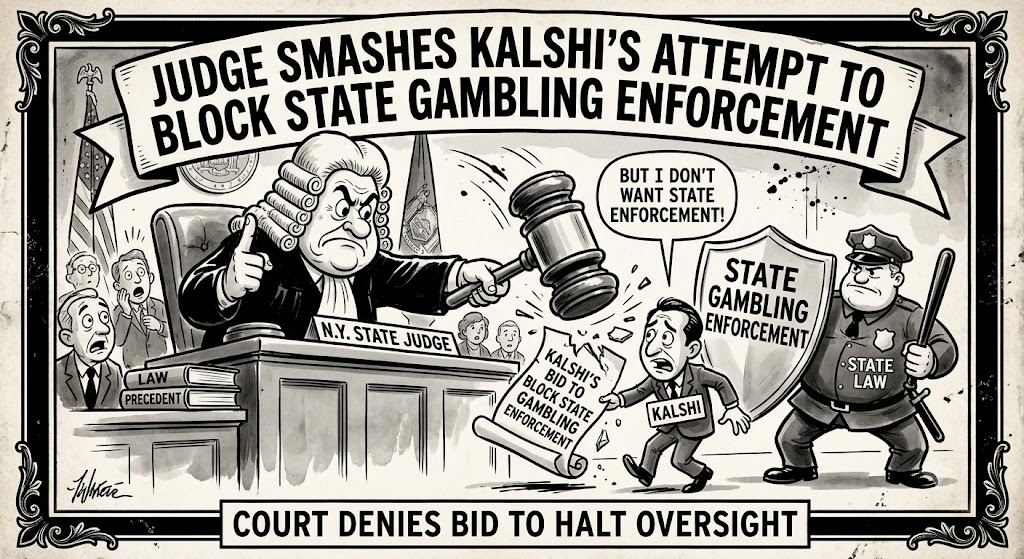
    The House Edge – New York Federal Judge blocks Kalshi

    THE LEAD

    Prediction markets: Kalshi lost in New York, where a federal judge rejected its core preemption theory on the merits for the first time. Deals: Icahn’s $33 rival bid surfaced against Fertitta’s $31 Caesars deal just as the go-shop closed, while an Icahn-linked director quietly left the board. Gray market: Indiana and Iowa’s sweepstakes bans took effect July 1, and Pennsylvania’s legislature is on a four-month clock to tax or kill skill games. Macau stayed soft into the World Cup final; the clean demand read starts July 20.

    THE BOOK

    US iGaming, Sports Betting & Prediction Markets

    Kalshi loses New York

    Background: the New York State Gaming Commission had moved to stop Kalshi from offering sports event contracts to New Yorkers, treating them as unlicensed sports betting. Kalshi sued and asked the court for a preliminary injunction, an order that would have barred the Commission from enforcing state law against it while the case plays out. Its argument, as everywhere else, was that the Commodity Exchange Act gives the CFTC exclusive jurisdiction and preempts state gambling law.

    On July 7, Judge Analisa Torres said no. Congress, she wrote, did not intend to “regulate so broadly as to exclude all state gambling laws from regulating transactions involving swaps.” Kalshi keeps operating for now, but it does so in its home state without legal protection, and the largest sports betting market in the country ($26B+ handle last year) is now genuinely at risk for it. Gaming lawyer Daniel Wallach called it a “major, major loss” with likely knock-on effects in Connecticut and the other New York federal suits.

    Why this matters more than last week’s Michigan injunction: Michigan was a state court pausing Kalshi’s operations before the main legal question was decided. New York was a federal judge actually deciding that question, and deciding it against Kalshi.

    The rest of the board

    FrontStatusNext date
    New YorkInjunction denied, CEA does not preemptCFTC’s parallel NY suit pending
    NevadaState supreme court denied Kalshi’s stay July 1Contempt hearing July 16; 9th Cir. ruling ~July 15
    MichiganTRO amended; Kalshi now geofencing the stateCourt evaluating geofence compliance
    ArizonaCFTC injunction blocks state criminal charges; both sides appealingArizona’s opening brief Aug 3
    Maryland (4th Cir.)Ruling pendingExpected by July 30
    MinnesotaBan signed into lawEffective Aug 1
    North CarolinaGov. Stein signed a 6% tax on PM net trading fee revenueIn effect via state budget

    North Carolina is the one to file away. A second camp of states is emerging that would rather tax prediction markets than fight them:

    StateTaxStatus
    Kentucky14.25% excise on transaction feesEnacted April 2026 (while the AG still sues Kalshi separately)
    IllinoisTiered transaction tax, folded into the sports wagering regime with licensingEnacted; Kalshi sued in June to block it
    North Carolina6% on net trading fee revenue from NC residentsSigned; effective Jan 1, 2027
    New Jersey9% surtaxBills advanced, pending

    North Carolina went furthest: its statute explicitly recognizes the CFTC’s “exclusive federal regulatory authority,” making it the first state to side with federal preemption while collecting revenue. And the rate design is the tell. NC sportsbooks pay 23% while prediction markets pay 6%, so a taxed-and-tolerated PM still holds a big cost advantage over the licensed book next door. Every state that taxes prediction markets implicitly legitimizes them, which cuts against the AGs suing to shut them down. The industry noticed too: the Coalition for Prediction Markets just hired former CFTC commissioner Brian Quintenz as senior advisor.

    Nevada: the Gaming Control Board asked the court to hold Kalshi in contempt for violating the May 18 order, and the July 16 hearing decides it. If Kalshi is held in contempt, that’s the first time a prediction market faces sanctions rather than just an order to stop. Separately, Nevada’s US senators (Rosen and Cortez Masto) are pushing to protect state oversight of prediction markets at the federal level. The incumbents put numbers on it. Nevada sports wagering is down $249M year to date, about 7% of the ~$3.5B wagered in the same five months last year, with April the worst month at -15%.

    Color from the week. Kalshi’s lifetime trading volume passed $100B, with a new daily record during the World Cup. Bloomberg reported (July 6) that the only people consistently making money on Kalshi and Polymarket are professional market makers, and a class action filed in the same New York court accuses Kalshi of collecting sensitive personal data from users.

    Burry’s Big bet: Michael Burry publicly backed sportsbooks on X to survive the prediction market threat.

    So what? Kalshi’s $40B valuation assumes its federal preemption theory wins. This week a federal judge in its home city said the theory is wrong, and two more appellate rulings land within three weeks. If the 9th Circuit sides with Nevada, there is a confirmed circuit split and this goes to the Supreme Court with momentum running against Kalshi. Watch July 15, 16, and 30.

    THE ORIENT

    Macau & Asia

    July is soft on weak demand. After June’s 12% decline, the sell side converged on a weak July: Citi models roughly MOP21.0B (down 5% YoY), Seaport sees down 7-9%, Deutsche Bank down 7.9%. All three attribute the softness to the World Cup and expect the daily run-rate to recover after the July 19 final, helped by a heavy concert calendar. Morgan Stanley cut its 2026 GGR estimate to ~MOP260.6B.

    Q2 market share. Seaport estimates Sands China gave back about 200bps of share in Q2, with Melco also losing ground, while Wynn and MGM posted the biggest gains.

    Context matters here: Sands had gained the most share of any operator in Q1, JP Morgan credited to record Londoner contribution and stepped-up promotional spend. Q2 looks like the give-back, as competitors matched reinvestment and Sands’ promo-led gains normalized.

    Korea: record revenue, 52-week-low stocks. The foreigner-only casino names all hit 12-month lows this month even as revenues run at all-time highs and inbound tourism keeps surging: Paradise Co at KRW12,220 and Grand Korea Leisure at KRW10,150 on July 3, Lotte Tour (Jeju Dream Tower) in late June. When stocks make new lows against record fundamentals, the market is pricing something structural, most plausibly the Chinese VIP concentration risk and the same money-flow scrutiny weighing on Macau.

    So what? The World Cup explanation gets tested the moment the tournament ends. If the daily rate doesn’t recover toward Citi’s MOP677M in late July, this is a demand problem and 2H consensus comes down further.

    THE OLD WORLD

    Europe + Canada

    UK costs keep stacking. The government confirmed the 25% license fee increase will land in full on October 1, rejecting the phased introduction operators lobbied for. That sits on top of the 40% remote gaming duty from April.

    Flutter is cutting costs in response to the UK tax increase, most visibly at PokerStars, which reduced headcount across Europe, Canada and the UK this week.

    France: land-based consolidation. Banijay Gaming, the standalone gambling division that already houses Betclic and Tipico, agreed to acquire Groupe JOA and its 33 French casinos from Blackstone and Kings Park Capital, with completion expected in 2H26 pending regulatory approvals. That assembles a French champion spanning retail casinos and online betting in one platform, and it puts a second consolidator on FDJ’s home turf just as FDJ digests Unibet. European gaming M&A is running hotter than the sector’s stock prices suggest.

    Spain goes after the prediction markets. The Spanish regulator opened disciplinary proceedings against Kalshi and Polymarket, citing insufficient identity verification and risk to minors, and signed a joint initiative with several other countries to share information and track prediction market activity. This is the first coordinated European enforcement move against the PM platforms, and it opens a second continent of legal exposure while the US fights are still running.

    So what? The August prints from Flutter and Entain are the first real evidence of whether cost cuts are holding UK margins, or whether customers are leaking to offshore sites offering better odds.

    THE LOCAL

    US Regional Gaming & Deal Watch

    Caesars: an 11th-hour bid, and a quiet exit that says more. Quick recap of the setup: Icahn built his Caesars stake to force a sale and unlock value, and in late May the board agreed to Tilman Fertitta’s $17.6B all-cash take-private at $31/share (a 49% premium to the unaffected February price; Fertitta assumes $11.9B of debt), with a go-shop window through July 11. This week gave us real drama. Icahn surfaced a $33/share rival bid, with Bloomberg reporting Jefferies was sounding out investors on ~$5B of debt to fund it.

    Yet the market isn’t buying it: Caesars closed Wednesday at $29.82, below both offers, and reports cited by Howard Stutz say the Icahn bid is unlikely to prevail. Then on July 10, Courtney Mather, the Vision One CEO who ran money at Icahn Enterprises and has sat on Caesars’ board since 2019, quietly resigned; no press release, profile simply removed. That’s the tell worth weighting. Icahn’s man leaving the board as the go-shop closes reads like the sale Icahn agitated for is getting done, with the $33 headline serving as a last squeeze on price rather than a serious attempt to own the company.

    Meanwhile Fertitta’s team gave Nevada regulators the full deal map on July 8, and it’s worth keeping: HSR antitrust filing lands July 13, gaming applications in the long-lead jurisdictions were due by July 10 with the rest within 45 days, and they estimate nine to ten months of regulatory approvals plus an SEC-reviewed proxy and shareholder vote before closing.

    One more nugget: Fertitta is keeping his 12.7% Wynn stake as a passive investment, so post-close he’d own Caesars outright and remain Wynn’s largest shareholder.

    The locals backdrop is softening. Las Vegas unemployment improved to 5.3% in May (from 5.8% in January) with 25,800 jobs added since the start of the year, but that’s still the third-highest rate among big US metros. Bad read for LV locals stocks.

    Elsewhere. Genting Americas raised a new $2B bank facility to refinance debt and fund the second phase of Resorts World NYC, real capital behind the only downstate license actually operating.

    So what? Caesars trading below both bids tells you the market is pricing deal timeline risk (nine-plus months of approvals) rather than doubting a deal happens.

    THE PROJECTS

    Global Greenfield & Development Watch

    • Wynn Al Marjan (UAE). Construction is at the final two floors, on target for a Q1 2027 opening.
    • MGM Osaka. Two supplier-side signals this week. Konami became the first manufacturer to file license applications with the Japan Casino Regulatory Commission, and the first to file across every applicable category. And Osaka opened its RFP for Phase 2 non-gaming development around the IR site. Konami moving first matters beyond bragging rights: Japan’s machine makers built their businesses on pachinko and pachislot, a market in long structural decline, and the regulated casino floor at MGM Osaka is the domestic pivot opportunity. Whoever gets licensed first shapes the supplier lineup for 2030, and it pressures Sega Sammy, Universal and the rest of the pachinko complex to follow or cede the new channel.

    So what? Wynn currently has the cleanest story in the sector: Q2 Macau share gains, a nine-month runway to Al Marjan.

    OTHER

    Sweepstakes & Skill Games

    Two related but distinct gray markets, both under pressure this week. Sweepstakes casinos are online: they sell “gold coins” for entertainment play and bundle in “sweep coins” redeemable for cash, a structure designed to avoid state gambling licenses. Skill games are physical: slot-style cash machines in bars, convenience stores and clubs whose makers argue a token skill element (spotting a pattern before spinning, for instance) exempts them from slot machine laws. Different products, same regulatory question: unlicensed, untaxed gambling.

    Sweepstakes: bans going live. Indiana and Iowa’s bans took effect July 1. VGW pulled every brand from Indiana (Chumba, LuckyLand, Global Poker), alongside Stake.us, McLuck, Hello Millions and High 5. Six states have enacted bans in 2026: California, Indiana, Maine, New York, Louisiana and Tennessee.

    Enforcement is the real question, and the earlier movers show how it escalates. Michigan’s gaming board has issued cease-and-desist orders since 2024, and Michigan and Arizona together sent more than 100 of them in 2025. New York’s law, signed last December, carries fines of $10,000 to $100,000 per violation and extends liability to payment processors, geolocation vendors and marketing affiliates; operators exited within weeks. That last part is the effective design: you don’t have to catch the offshore operator if their payment rails won’t touch them. Indiana looks early-stage by comparison, with tracking showing dozens of platforms still accepting Indiana players on July 2. Expect the C&D wave and processor pressure to follow.

    Skill games: Pennsylvania’s four-month clock. The PA Supreme Court ruled in June that skill games are slot machines under state law, but stayed enforcement for 120 days, giving the legislature until roughly October to regulate them. The fight is now purely about the tax rate:

    ProposalRate
    Gov. Shapiro (D)52% of revenue, matching casino slots; ~$800M year-one projection
    Senate GOP35% or 16% competing bills
    Bipartisan alternative$500 flat fee per machine per month

    So what? Both gray markets are being pushed onto the same fork: get taxed and regulated, or get banned. Either branch helps licensed operators. For Pennsylvania specifically, a rate near 52% erases the machines’ economic edge over casino slots; a rate near 16% entrenches it. High 5 Games is the name to watch, since it operates sweepstakes while holding licensed supplier status, an increasingly awkward combination.

    THE SHIFT

    Moves & Shakers

    • Caesars: Courtney Mather (Vision One CEO, ex-Icahn Enterprises portfolio manager) resigned from the board after seven years, as the Fertitta go-shop window closed. See THE LOCAL for why this reads as a positive.
    • DICJ (Macau gaming regulator): Lio Chi Chong, the deputy director, is serving as Acting Director after Ng Wai Han’s promotion to Secretary of Economy and Finance. Worth watching who gets the permanent seat; the DICJ director sets the tone on concession compliance.
    • Coalition for Prediction Markets: former CFTC commissioner Brian Quintenz joins as senior advisor.

    THE NUMBER

    52% is Shapiro’s proposed tax on Pennsylvania skill-game revenue, worth ~$800M in year one by his administration’s math. Where the legislature lands between 16% and 52% by October decides whether the gray-machine economy survives in its biggest state.

    THE CALENDAR

    DateEvent
    July 11Caesars go-shop window closed (watch for confirmation Fertitta deal proceeds)
    July 13Fertitta files HSR antitrust application for Caesars deal
    ~July 159th Circuit ruling expected, Kalshi v. Nevada
    July 16Nevada contempt hearing (Kalshi)
    July 19World Cup final; Macau’s clean demand read begins
    July 29MGM Q2 earnings (first forced disclosure point on the Diller offer)
    ~July 304th Circuit ruling expected, Kalshi v. Maryland
    July 31 / Aug 3Flutter’s last LSE trading day / delisting
    Aug 1Minnesota prediction market ban effective
    Early AugFlutter Q2 update; Bally’s LVCVA financing deadline
    Aug 13Entain interims
  • The House Edge —  Michigan blocks Kalshi Sports Contract

    The House Edge — Michigan blocks Kalshi Sports Contract

    Issue #05 | July 5, 2026


    THE LEAD

    Three things define the past two weeks. First: the prediction market legal war crossed a structural threshold — states are now racing to file pre-merits injunctions before federal preemption resolves, the CFTC is suing states back, and the Supreme Court may weigh in this fall. No single ruling ends this; it’s now a multi-year war of attrition. Second: Macau’s June GGR badly missed at -12% YoY, the weakest month since September 2025 — but CLSA’s July 2 demand survey is the most constructive consumer read in over a year, and those two datapoints say very different things about the 3Q setup. Third: DraftKings launched its own PM exchange the same week Kalshi raised at a $40B valuation, pulling every major gaming operator into a market-making arms race whose legal status in half the country remains unresolved.


    THE BOOK

    US iGaming, Sports Betting & Prediction Markets

    PM Legal: The Four-Front Escalation

    • Michigan injunction — the template, not the fine. A Michigan state court temporarily halted Kalshi’s sports-event contracts. What matters isn’t the dollar amount — at Kalshi’s ~$2B annualized revenue, it’s immaterial. What matters is the procedural template: a state court can geofence Kalshi’s sports book before the federal preemption question is resolved at circuit level. Every state AG now has the roadmap. The Michigan Gaming Control Board also resigned from the National Council on Problem Gambling after the council refused to remove Kalshi as a member.
    • CFTC goes on offense. The CFTC filed to preempt Kentucky and New Mexico state restrictions. Simultaneously, a Kentucky coalition sued to block the state’s 14.25% PM tax — and the Kentucky AG’s existing suit against Kalshi and Polymarket continues. Kentucky is now a two-front battlefield.
    • Massachusetts adds a copyable new theory. The MA AG expanded its suit with an under-21 targeting claim that other state AGs can copy immediately, without waiting for preemption rulings.
    • NJ plays both angles. The New Jersey AG filed for a SCOTUS cert petition extension on July 1, asking the Court to weigh in on whether PM contracts constitute illegal sports betting. Trenton simultaneously advanced a 9% PM tax bill through committee.
    • Calendar: 9th Circuit ruling on Kalshi v. Nevada expected by July 15 — panel was skeptical at oral arguments. 4th Circuit on Kalshi v. Maryland by July 30. Kalshi v. Mescalero Apache raises IGRA vs. CFTC preemption with no clean precedent.
    • Polymarket under the microscope. Reports cite $1.9M in payments to fake bet creators, a CMO who ran $2.5M in influencer spend through a personal PayPal, and 20% of UMA oracle judges betting on their own rulings. Bipartisan Senate letter demanded a CFTC investigation. Exchange designation at risk.
    • Schiff-Curtis bill introduced. Bipartisan legislation to ban sports-event contracts from CFTC exchanges entirely — legislative risk equity investors are underpricing.

    PM Volume & Fundraising

    Combined Kalshi + Polymarket June volume: ~$45B, up ~75% YoY on World Cup activity. Kalshi running at ~$2B annualized revenue, raising at a $40B valuation (from $22B earlier this year), with preliminary IPO conversations underway. Most underappreciated distribution story: Cboe Predicts + Charles Schwab, which puts PM contracts in front of 39M brokerage accounts with no CFTC registration friction. Trump Jr. disclosed a $300K equity stake in Kalshi.

    DraftKings Exchange (DKeX) Launch

    DraftKings launched DKeX, its own internal market-making unit, vertically integrating its PM product for the first time. CEO Jason Robins cited $3B+ annualized consumer volume on DraftKings Predictions; stock jumped 11% on announcement. DraftKings guided to $200-300M in PM category losses in 2026; BofA estimates $550M; Citizens Bank models $243M in market-making revenue by 2027 at ~95% gross margins.

    OSB: Ohio Rollback + Nebraska Ballot

    Ohio legislators introduced the Save Ohio Sports Act to end mobile sports betting in the state — direct earnings exposure for DraftKings and Flutter. Nebraska cleared 350K petition signatures, putting OSB legalization on the 2026 General Election ballot.

    So what? The pre-merits injunction is the structural breakthrough: states don’t need to win on federal preemption, they just need to impose a temporary operational freeze while the federal clock ticks. For Kalshi, legal exposure is now a budget line — the question at $40B valuation is whether $200-400M in annual legal/compliance spend at scale is priced in. On DraftKings, the DKeX bet is structurally correct but 2026 EBITDA guidance spans a wide band. On Polymarket, exchange designation is the tail risk. Nebraska is the OSB signal to watch: a conservative rural-state ballot win de-risks remaining holdouts more than any lobbying effort.


    THE ORIENT

    Macau & Asia

    • June GGR: a miss that complicates the demand picture. June GGR: MOP18.5B ($2.29B), -12.1% YoY and -18.1% MoM — lowest since September 2025. Consensus was tracking ~MOP20B. 1H26 total: MOP126.9B, +6.8% YoY. The miss looks like broader consumer softness, not a one-off event — which is what makes CLSA’s July 2 demand survey of 800 mainland Chinese interesting and hard to reconcile. 79% plan to visit Macau in the next 12 months; gaming wallet share expanded to 24% from 19% in 2025; top income cohorts reported the highest likelihood of increasing spend.
    • Analyst commentary. Moody’s: Asia GGR +5% over next 18 months, constructive. Wynn group credit outlook cut from “positive” to “stable” on elevated leverage.
    • Singapore Greater Sentosa Master Plan (July 5). Singapore unveiled a 20-year vision: doubles visitation targets, integrates Brani Island, embeds RWS 2.0 as the anchor. Implementation begins early 2030s. For Genting Singapore, this anchors the expansion inside a government-backed precinct.
    • SJM CFO change. Christopher Ip departed June 29; Sean Czoon Tan (former NagaCorp CFO) named successor.
    • Brief items. Lawrence Ho met Kazakhstan’s PM on Alatau City “Green District” — early dialogue, no licensing timeline. MGM China acquired MGM Asia-Pacific for $20M: light-asset hotel management, not material.

    So what? The June miss and the CLSA survey point in opposite directions. A -12% YoY print against 79% stated visit intent is a wide gap — either the premium mass consumer is deferring spend (temporary) or the survey is overstating demand (structural). 3Q data resolves this: if GGR recovers in July-August, it reinforces the survey; if it stays soft, consensus needs to come down for 2H.


    THE OLD WORLD

    Europe

    • UK: new cost layer on top of known ones. Operators have sized the RGD hike (21% → 40%) via marketing cuts and RTP adjustments. The new item: UK gambling license fees rise 25% from October 2026 — another fixed cost layer. Black market risk is real but slow-moving: UK licensed RTPs at 90-95% vs. 96-98% offshore, alongside mandatory affordability checks.
    • Entain called on the UK’s independent football regulator to ban unlicensed gambling sponsorships — a compliance positioning move heading into H2 regulatory discussions.
    • Italy (Lottomatica): Steady Q1 growth driven by online momentum despite low sports betting hold — Italian iGaming remains the cleanest structural growth story in Southern Europe.
    • Spain (DGOJ): Regulator fined a production company for promoting an unlicensed operator — enforcement tightening, relevant for Cirsa’s retail operations.
    • France: No material news this period. FDJ/Unibet is the primary listed name to track.
    • Greece (OPAP): OPAP remains the dominant regulated operator. Allwyn holds a significant stake. No material news this period.
    • Canada (Great Canadian / One Toronto Gaming): Great Canadian (Apollo-owned) and One Toronto Gaming (Hard Rock/Great Canadian consortium). No material news this period.

    So what? The UK’s regulatory stack is compounding: RGD at 40%, license fees up 25% from October, affordability checks still contentious. Operators managed earnings impact via marketing cuts, but channelisation is the medium-term risk. Entain and Flutter are primary exposures; Cirsa’s risk is whether Spain/Italy follow the UK template on digital taxation.


    THE LOCAL

    US Regional Gaming

    NYC Casino: State of Play

    PropertyDeveloperStatusTarget Opening
    Resorts World NYCGenting✅ Open — live table games since May 2026
    Bally’s BronxBally’s CorpConstruction start Aug/Sep 2026Mid-2030
    Hard Rock Metropolitan ParkHard Rock⚠️ Pre-construction; foundation testing not yet begun2030 (at risk)

    Bally’s: Three-Front Pressure

    Bally’s is simultaneously stressed on all three major US projects. Chicago: VGTs legalized citywide — ~$75M annual revenue impact, ~1,000 jobs at risk. Las Vegas: LVCVA wants a financing plan by August; only retail/entertainment district ready by 2028 (not the towers). Bronx: $4B project, Aug/Sep start targeted, not yet broken ground. Balance sheet: $559M cash vs. $4.3B net debt and $2.2B lease liabilities. Stock down 15% in six months.

    Brazil H1 Gaming

    Brazil’s regulated sector generated BRL5.89B ($1.18B) in Jan-May 2026, +86% YoY. World Cup accelerated inflows — BRL510M transferred in the first three weeks of the tournament alone. Full-year annualized pace: ~BRL14B ($2.8B).

    So what? Las Vegas is Bally’s most acute near-term risk — an inadequate financing plan by August likely triggers Nevada Gaming Commission escalation. Chicago is a longer fuse but a real revenue hole. On Brazil: the market is now large enough to move Flutter, bet365, and Sportingbet earnings. Bally’s Bronx construction start this fall is the NYC catalyst; Hard Rock’s foundation delay makes its 2030 target increasingly aspirational.


    THE PROJECTS

    Global Greenfield & Development Watch

    • Singapore Greater Sentosa — covered above in THE ORIENT.
    • Kazakhstan / Melco — Lawrence Ho met Kazakhstan’s PM on Alatau City “Green District.” Government dialogue only; no licensing process underway.

    THE SHIFT

    Moves & Shakers

    • SJM Holdings: CFO Christopher Ip out June 29; Sean Czoon Tan (ex-NagaCorp CFO) named successor.
    • Kalshi: Donald Trump Jr. disclosed a $300K equity stake acquired prior to the current $40B fundraising round.

    THE NUMBER

    79% — Percentage of 800 mainland Chinese surveyed by CLSA (July 2) who plan to visit Macau in the next 12 months, alongside gaming wallet share that expanded to 24% from 19% in 2025. Against a June GGR that badly missed, this is the data point most likely to determine whether Macau stocks re-rate higher into 3Q.


  • The House Edge #3 | June 13, 2026

    The House Edge #3 | June 13, 2026

    What the house knows. Occasionally.

    Issue #03 | June 13, 2026

    THE LEAD

    The CFTC draws the line — and most of prediction markets lands on the legal side

    On Wednesday, the CFTC dropped its 267-page NPRM on prediction markets. Most concrete regulatory signal the industry has received. Market reaction told you almost everything: DraftKings and Flutter both rallied. Prediction market operators shrugged and kept building.

    The short version:

    • In: Aggregate sports outcomes — scores, win-loss, brackets, season stats. Everything currently live on Kalshi, ProphetX, and Robinhood.
    • Out/flagged: Pitch-by-pitch micro-markets, in-game live props, player injury contracts, officiating decision markets, sub-collegiate sports.
    • Explicitly protected: Elections and politics — carved out of the “gaming” definition. Kalshi’s highest-volume vertical is untouched.
    • Banned: War, terrorism, assassination contracts.

    Rules hit the Federal Register Friday, 45-day comment period open. Comments due July 27. Final rule is a 2027 story.

    Industry split cleanly along self-interest. AGA President Bill Miller called it a “remarkable attempt” to redefine sports betting. Former CFTC Chair Gary Gensler went on CNBC and said he doesn’t think the CFTC has authority over sports wagering — as a key architect of Dodd-Frank’s derivatives framework, the same law underpinning the CFTC’s jurisdictional claim, that’s not a fringe view. ProphetX (received its DCM approval the same week) called it “a level regulatory playing field.” Same document, four different reads.

    The NPRM’s real constraint isn’t the comment period — it’s Congress. Two draft bills circulating the same week could cut through the CFTC’s framework entirely. The Prediction Markets Are Gambling Act (S.4160, Schiff D-CA / Curtis R-UT / Cortez Masto D-NV) would amend the Commodity Exchange Act — the federal law that gives the CFTC its regulatory authority — to explicitly ban licensed exchanges from listing sports or casino-style prediction contracts. Neither bill has passed, and both face a difficult path in the current Congress. But the structural threat is real: the CFTC has been beating state bans by arguing that federal law permits prediction markets, so states can’t block what federal law allows. If Congress amends that same law to say sports contracts are prohibited, the protection disappears entirely — you can’t claim federal cover for something the federal statute itself bans. Separately, the broader digital assets market structure bill (CLARITY Act) moving through the Senate has become a live amendment fight, with a broad coalition — casino operators (AGA), tribal gaming groups, equipment manufacturers, and labor unions (AFL-CIO Hotel & Gaming Trades Council, UNITE HERE) — jointly writing to urge ban language be included. When tribal gaming and hotel unions sign the same letter, the political weight is real.

    So what? The NPRM does two things — one real, one symbolic. Real: draws a line between prediction markets and a sportsbook, and most of what’s currently offered lands on the legal side. Symbolic: the CFTC is telling states it owns this space. That fight isn’t over — Gensler’s framing gives state challenges a credible intellectual foundation, and a Supreme Court test looks likely. But the investment read isn’t “prediction markets get capped.” It’s “prediction markets just became a regulated asset class.” DraftKings committed up to $300M to its Predictions product in 2026; Flutter $250–300M on FanDuel Predicts. They’re not fighting the tide. August 1 (Minnesota’s felony statute) remains the real catalyst — and it sharpened: the CFTC has now filed its own federal lawsuit to block the Minnesota law, joining Kalshi and Polymarket. Three plaintiffs, federal preemption argument in full. Not the comment period. If either bill advances, it’s unambiguously good for OSB, bad for prediction markets: sports prediction contracts would be federally capped, and the same federal preemption argument that’s been protecting prediction markets from state bans becomes the mechanism that kills them. These are drafts with uncertain odds — but unlike the state-level fights, there’s no legal appeal if Congress acts. That tail risk isn’t priced into DKNG’s Predictions investment or Kalshi’s valuation.


    THE BOOK

    iGaming: the one segment that isn’t broken

    April GGR across seven live states: ~$1.0B, +15% YoY. The structural reason is straightforward — iGaming has no federal preemption problem. Kalshi doesn’t offer digital blackjack.

    NY (30.5% proposed tax) and Illinois (25%) are the two material expansion catalysts. Neither moves before 2027. But the trend line is clear.

    World Cup footnote: Kalshi handled ~$188.6M in World Cup futures on opening weekend (preliminary, as of publication; total World Cup volume has since crossed $300M). DKNG and FLUT are both ramping marketing through the group stage to acquire users for their prediction market products — first real mass-market test of whether consumers distinguish between a sportsbook parlay and a prediction market contract.

    So what? iGaming is the cleaner compounder — no Supreme Court dependency. If NY passes at 30.5%, you get a step-change re-rate across the online names. On prediction markets, watch August 1, not the comment period.


    THE ORIENT

    Pansy Ho exits the parent. Watch what she buys next.

    Between May 28–June 3, Pansy Ho sold her entire 1.2% MGM Resorts stake. $140M. Liquidated a position held since 2011. She still holds 22.49% of MGM China and remains co-chairperson.

    This isn’t an exit. It’s a repositioning. If People Inc. closes its MGM Resorts bid, Diller’s historical playbook (IAC → Match, Expedia, Angi: acquire-restructure-spin) almost certainly makes MGM China and Osaka non-core. The question is who buys MGM Resorts’ 55.95% MGM China stake — and the answer narrows quickly.

    Macau’s 2022 gaming law effectively bars existing concessionaires from acquiring a controlling stake in a competing concession holder without DICJ approval — which in practice would almost certainly be denied. The government spent years consolidating to six concessions specifically to prevent cross-ownership concentration. That structural bar rules out Galaxy and Sands regardless of their financial capacity or political standing.

    The actual buyer universe:

    • Pansy Ho — Natural anchor buyer. Freed up $140M, holds 22.49% already, and her government-adjacent relationship is a genuine asset. $140M is small relative to the implied stake value — needs financial partners, but is the most credible lead.
    • Financial sponsors — PE (Blackstone, Ares, Apollo) or sovereign wealth funds (GIC, Temasek) structured as a consortium with Pansy Ho as operating anchor. No regulatory conflict, deep capital. The most realistic path.
    • New entrant — Theoretically someone outside the current six seeking Macau exposure. But the gaming concession itself doesn’t transfer with the equity, which limits strategic value for a pure-play acquirer.

    Bond wrinkle: CreditSights flags 2027 and 2031 MGM China bonds likely retain COC protection (put at $101); 2033 bonds may not (holding company exception). With $2.7B total debt against $918M cash — flagged as insufficient to service independently — the bond market needs to price the ownership path before the equity can trade cleanly.

    May GGR: MOP 22.61B (+6.7% YoY), beat vs. Jefferies/Citi. YTD through May: +10.9%. Strongest May since the pandemic. Caveat: two holiday tailwinds (Labour Day + Buddha’s Birthday). Holiday months overstate the run rate — the YTD trajectory is the cleaner signal.

    Base mass still ~15% below 2019. Operators haven’t recovered the market — they’ve gotten better at monetizing the visitors who show up.

    So what? 2026 GGR tracking to beat consensus (+8%+ vs. ~6% street). Sector positive. Galaxy and Sands are the cleaner plays on fundamentals — but not viable buyers of MGM China under current law. The MGM China stake disposition path runs through financial sponsors anchored by Pansy Ho, not intra-industry consolidation. MGM China is a deal-optionality trade, not an operational one. Wynn (1128.HK) remains the last large-cap premium pure play without an ownership overhang — and with CZR + MGM both heading private, it becomes the default institutional vehicle for large-cap gaming exposure.


    THE STRIP

    Holding pattern

    No Nevada May data until late June. World Cup is live — US opened Friday vs. Paraguay. Strip as host city upside is real but Q3-weighted. Visa barriers are still suppressing cross-border arrivals. Watch September and October LVCVA prints, not Q2.


  • The House Edge | Issue #2

    The House Edge | Issue #2

    What the house knows. Occasionally.

    Issue #02 | June 6, 2026


    THE LEAD

    Two deals, $35B+, one week: US public gaming is being taken private. Fertitta Entertainment agreed on May 28 to buy Caesars for $17.6B ($31/share, 49% premium, $11.9B debt assumed) — the largest casino acquisition in US history. Four days later, People Inc. (Barry Diller’s IAC vehicle, existing 26.1% MGM holder) submitted a non-binding $18B offer for the rest of MGM at $48.30/share (+10.6% to May 29 close). The Caesars deal is not conditioned on financing — the 10-bank syndicate has committed the debt. MGM’s financing remains open. Both are going to define the gaming sector for the rest of 2026.


    THE BOOK

    US iGaming, Sports Betting & Prediction Markets

    • iGaming legalization in 2026 is off the table — the story is now 2027. Legislative windows have closed in every active market. New York (SB/AB, Addabbo/Woerner, 30.5% GGR tax) and Illinois (HB 4797 / SB 3723, 25% GGR tax) are the only credible bills to monitor, and neither will move before 2027 sessions. Don’t fight the tape on new state launches this year.
    • Online Sports Betting — Q1 2026 GGR: $3.82B (-10.5% YoY vs. $4.27B in Q1 2025). Handle: $40.47B (-7.0% YoY). DraftKings -25% YTD, Flutter -50% YTD. No new data this week; the Q1 miss was the confirming print.
    • Prediction Markets — watch August 1. Minnesota’s SF4760 (Gov. Walz, D-MN, signed May 18) makes operating prediction markets a felony, effective August 1. Three plaintiffs now: CFTC, Kalshi, and Polymarket all filed separately. CFTC is seeking a preliminary injunction — no hearing date set, expect scheduling within 3-4 weeks. CFTC has filed against six states in 2026 (AZ, CT, IL, WI, MN, RI); federal scoreboard 3-0 for Kalshi. Total prediction market notional volume hit ~$28.4B in May 2026 (per The Block), a new monthly record — up from under $5B/month in September 2025 and ~$24B in April 2026 (per Pew Research Center). For context, US legal sportsbooks handle roughly $13-14B/month; prediction market notional volume now exceeds US OSB handle in absolute terms, though the metrics are not directly comparable (notional contract value vs. actual wagers). Illinois took a different approach: a 1.75% tax on sports event contracts — the first state to tax rather than ban. DraftKings self-certified six CFTC contracts for its DKeX exchange, bypassing Kalshi’s rails entirely. Robinhood is routing World Cup contracts to Rothera — the first major Kalshi distribution defection. AGA estimates states have collectively lost $1B+ in gaming tax revenue to prediction markets.
    • Every major OSB operator is now hedging into prediction markets — the DCM arms race is the clearest confirmation that cannibalization is real. Since early 2025: 17 new CFTC DCM applications filed, 7 approved. DraftKings acquired Railbird Exchange (Oct 2025). Fanatics launched in December 2025 — first traditional sportsbook brand on CFTC-regulated rails. Rush Street Interactive filed May 20 under “Eventive III,” reversing February 2026 management comments that they had no interest in the space. Kalshi peaked at $720M in a single NFL week; studies estimate prediction markets have driven up to a 5-10% decline in OSB handle in legal states. Prediction markets operate in all 50 states; licensed OSB is in ~38. The OSB network advantage doesn’t translate when any operator can go federal.

    So what? The Illinois 1.75% tax sounds like a policy win but it isn’t parity — Illinois taxes OSB at 40% and iGaming at 25%; 1.75% on prediction market contracts doesn’t come close to offsetting the AGA’s $1B state revenue loss figure. The more fundamental issue is federal preemption: if the CFTC prevails, states may not have the authority to regulate (or tax) federally licensed event contracts at all — which makes the Illinois model a legal question mark, not a template. What it does signal is that state governments are searching for a regulatory handle over an industry that currently operates with almost no state oversight. That’s the relevant read: not a structural positive for DKNG/FLUT, but increasing evidence that prediction markets will face more regulatory friction over time. August 1 forces the preemption issue; if CFTC wins, state bans fall — and the legality of state taxes on CFTC-regulated contracts gets tested next. Meanwhile the DCM filing wave confirms what management won’t say publicly: cannibalization is real, and the defensive play is to own the competitor.


    THE STRIP

    Las Vegas

    • April Strip GGR: $689.4M (+6.6% YoY) — but the hold rate did the work. Nevada statewide set an April record at $1.3B (+5.3% YoY). Strip baccarat hold ran at 16.5% vs. 14.0% last April — strip out that variance and the underlying volume trend is closer to flat. Visitors fell 1.8% YoY to 3.28M. Higher revenue on fewer visitors = higher spend per head, which is the one structural positive in the print.
    • Caesars/MGM — what the 7x multiple actually means. The Fertitta/CZR deal implies ~7x CY27E EV/EBITDA on a blended Las Vegas + regional portfolio. That’s a discount to where both stocks traded over the past year, but the deal structure matters: CZR owns its Las Vegas real estate (60% of LV EBITDA is PropCo-derived), while MGM is a pure OpCo — it sold its properties to VICI and pays ~$2B/year in rent. Buying MGM means buying cash flow, not land. The headline multiple comparison overstates MGM’s implied value. Both portfolios include heavy regional exposure, so the 7x floor is for a blended asset base, not a Strip-only premium.
    CZR (Fertitta)MGM (People Inc.)
    Deal EV$17.6B~$18B
    Price/share$31.00 (+49% to unaffected)$48.30 (+10.6% to 30-day VWAP)
    Deal EV/CY27E EBITDA~7x~6-7x (est.)
    1-yr avg trading multiple~8.9x~7.1x
    3-yr avg trading multiple~8-9x~7-8x
    LTM Adj. EBITDA~$3.6B~$2.4B consolidated (see breakdown below)
    Real estate structurePropCo (owns LV land)OpCo (VICI-leased, ~$2.3B/yr rent)
    Net debt (Q1 2026)$11.1B ($11.9B gross – $867M cash)$4.1B ($6.4B gross – $2.3B cash)
    Equity fundingFertitta Entertainment equity; Carano family (~5%) rolling equityPeople Inc. cash on hand; equity co-investors (TBD); People Inc. targeting 50.1%+
    Debt fundingNew 10-bank syndicate (Morgan Stanley / Goldman Sachs leads); $11.9B existing CZR debt assumed; deal not conditioned on financing — bank commitment in placeMGM existing $6.4B debt; new debt financing TBD; no financing condition stated

    Leverage Bridge — LTM Q1 2026 (FY 2025 + Q1 2026 − Q1 2025)

    MetricCZRMGM ConsolidatedMGM US-onlyMGM China (56% attr.)
    Gross debt$11.9B$6.4B$3.7B$2.7B (100%)
    Cash$0.9B$2.3B$1.4B$0.9B (100%)
    Net debt (reported)$11.0B$4.1B$2.4B~$1.0B (attr.)
    • VICI / operating lease obligation+$11.7B+$24.9B+$24.9Bminimal
    Adj. net debt (lease-inclusive)~$22.7B~$29.0B~$27.3B~$1.0B
    LTM EBITDAR~$3.6B~$4.6B~$3.4B~$0.67B (attr.)
    Lease-adj. net leverage~6x~6.3x~8.0x~1.5x
    • Wynn is the last large-cap pure play. With CZR going private and MGM likely following, Wynn ($10.9B market cap, LV + Macau only, no regional) is the only remaining liquid gaming operator for institutional capital.
    • People Inc.’s angle on MGM is unanswered. The offer is non-binding, the premium is thin (10.6%), and there’s no stated value creation thesis. IAC’s playbook is acquire-restructure-spin (Match, Expedia, Angi) — applying that to a hotel/casino operator is different. Watch for MGM board go-shop activity; at 10.6%, this doesn’t sound attractive.
    • CZR’s deal is specifically structured to avoid triggering change-of-control — but that structure carries execution risk. Per Octus legal analysis, Fertitta does not qualify as a Permitted Holder under Caesars’ bond indentures and credit agreement. An acquisition resulting in Fertitta controlling >50% of CZR’s voting equity would trigger the COC definition — requiring Caesars to offer to purchase the bonds at $101 (not a default, but a costly tender). To avoid this, the deal is structured so Fertitta holds ≤50% of voting equity, with the Carano family (~5% existing holders, qualifying as Permitted Holders) rolling equity alongside Fertitta into a Permitted Holder Group — ensuring no non-Permitted Holder holds a majority of the group’s voting equity. The CZR bond indentures do not contain a separate ratings-downgrade COC trigger; the only trip-wire is the beneficial ownership test. The $11.9B debt stack stays at current rates if the structure holds through close. CZR bonds fell anyway — the market is pricing execution risk on whether the avoidance structure survives regulatory and legal scrutiny through close.
    • MGM China bond risk is the unmodeled overhang in the People Inc. deal. CreditSights flags that if People Inc. acquires >50% of MGM and triggers a ratings downgrade, bondholders can put $2B of MGM China bonds at $101. The MGM China revolving credit facility ($663M) gets canceled under the same scenario. MGM China carries $918M cash against $2.7B total debt — CreditSights says that’s insufficient to service the stack independently. That said, it is unclear on which silo the new MGM complex will be under.
    • VICI: CZR’s delveraging story is the upside. If Fertitta’s path to deleveraging CZR’s $11.9B debt stack is asset sales, VICI is the natural buyer of Caesars LV real estate in a sale-leaseback. That’s an acquisition opportunity for VICI.
    • World Cup: a Q3/Q4 story, with a caveat. Las Vegas is a host city, but per an AHLA survey of 200+ hotels across 11 US host cities, nearly 80% report bookings tracking below initial forecasts. Visa barriers and immigration uncertainty are suppressing cross-border travel; Nevada legislators are fighting border rules in real time. Any benefit runs through H2 — watch the September and October LVCVA prints, not Q2.

    So what? April’s hold-inflated print is noise. The M&A read-through is real but context-dependent — a 7x blended multiple on CZR (PropCo + regional) doesn’t auto-translate to a 7x re-rate for premium-only names. Wynn is the forced-buy thesis; it doesn’t need the M&A multiple to matter, it just needs institutional capital to have nowhere else to go in large-cap gaming. VICI’s Caesars lease is a potential catalyst simultaneously — that duality isn’t in the stock price.


    THE LOCAL

    US Regional

    Las Vegas Locals

    • Red Rock 1Q26: $507.3M revenue (+1.9% YoY, record Q1), adj. EBITDA $212.6M (-1.2% YoY). Construction disruption at Durango, Sunset Station, and Green Valley Ranch is compressing margins — management flagged as temporary. The more important number: Red Rock holds 454 acres of developable LV land. The South Strip site (123 acres, roughly Red Rock Casino scale) set the price floor.
    • LV metro unemployment hit 5.8% in January 2026 — a multi-year high — and has since moderated to 5.4% in March 2026 (per DETR), up from approximately 4.7% in March 2025. Leisure & Hospitality shed 2,800 jobs in March, even as total LV nonfarm employment is up ~19,800 YoY. Strip employment is the primary income base for the locals market; a sustained jobs downturn is a demand headwind that hasn’t been fully modeled into Red Rock estimates.

    New Jersey

    • Q1 2026 total gaming revenue $725.6M (-0.6% YoY). Casino operating profit collapsed 22.9% YoY on flat revenue — a cost story, for now. Resorts World Queens opened live tables (blackjack, craps, baccarat, roulette) on May 5 — the first in NYC in decades.
    • April 2026 NJ total GGR: $600.8M (+12.0% YoY vs. $536.6M) — retail casino win $235.6M (+11.7%, 12-year April high), iGaming $263.1M (+11.9%), sports wagering $102.1M (+12.8%) on $934.2M handle. April is the last clean pre-NYC-tables baseline; Resorts World’s live tables didn’t open until May 5. May 2026 data (not yet released by NJ DGE) will be the first read on whether NYC is cannibalizing Atlantic City retail volumes — watch for it mid-June.

    Canada

    • One Toronto Gaming (Great Canadian + Brookfield) took a $120K AGCO fine for a dealer collusion scheme at the Great Canadian Casino Resort Toronto. Not material in isolation, but a compliance flag at Canada’s largest casino (4,800+ slots, 175 live tables). The bigger context: Canadian arrivals to Las Vegas are down 17.4% YoY — MGM’s Hornbuckle put it at -30-40% at his properties specifically.

    So what? NJ’s EBITDA compression will accelerate now that NYC tables are live — the catch-up trade in AC requires either iGaming or a structural cost reset, neither of which is imminent. Red Rock’s land optionality is the cleanest catalyst option in locals; any South Strip announcement changes the thesis. Canada’s visitation drop is the most underdiscussed drag on LV Strip numbers right now.


    THE ORIENT

    Macau & Asia

    • Macau May GGR: MOP 22.61B (~$2.80B), +6.7% YoY / +13.7% MoM — beat the consensus range (+6.6-8.5%). April’s MoM dip was hold noise, as framed last week. YTD 5-month total: MOP 108.38B (+10.9% YoY). Labour Day (May 1-5) drew 873K visitors (~174,600/day).
    • MGM China Q1 — Revenue +9% YoY to $1.1B; daily mass GGR hit an MGM China historical high. China operations are a separate HK-listed entity (HK:2282) — People Inc.’s offer for MGM parent should have no impact on MGM China, but capital allocation decisions (growth investment in Macau vs. US deleveraging) will be a consideration.
    • Market share (Q1 2026, JP Morgan) — Sands China 26.2% (+1.5pp QoQ, largest gainer; Londoner driving it). Galaxy ~20.3% (-1.6pp QoQ). MGM ~16.2% (-0.4pp). Melco ~15.1% (+0.9pp). Wynn ~13.4% (+1.2pp). SJM ~9.9% (-0.6pp).
    • Outlook — CBRE: +8.3% full-year 2026. Seaport: growth slows in H2 on tougher comps. Morgan Stanley: EBITDA flow-through “weak” across all six operators as concession reinvestment compresses margins.
    • China outbound-investment rules take effect July 1 — CLSA calls it a sentiment headwind, not a GGR headwind. The State Council regulation (signed June 1) requires approval for overseas transfer of goods, technology, services, and data subject to export controls, and bans indirect cross-border transfers via consulting, training, or technical personnel arrangements. It introduces ongoing “full-process supervision” of outbound investments — including to Hong Kong, Macau, and Taiwan. For Macau gaming, the rules target capital repatriation channels, not gaming budgets: Macau gaming spending runs ~48% cash / 42% UnionPay, neither of which falls under the new regime. CLSA forecasts +5% full-year GGR growth and June at -0.65% YoY on tough comps. Stock sentiment will be choppy into July 1; the underlying demand picture doesn’t change.

    So what? The recovery is intact — May confirms it. Wynn Macau is still the cleanest exposure to premium mass: gaining share, smaller balance sheet, no Londoner-scale capex drag. National Golden Week (October) is the next catalyst that can move estimates. The July 1 outbound-investment rules are the near-term noise trade — own the dip if it comes. For MGM China specifically, watch whether a private MGM parent signals any change in Macau growth investment — it’s the one strategic variable a going-private introduces that isn’t priced.


    THE NUMBER

    Stat of the week

    $487M — Churchill Downs Derby Week 2026 total handle, +3% YoY vs. $473.9M in 2025. Derby Day handle itself fell slightly to $340M (-2.6% vs. $349M record). The Derby alone is worth roughly 20x EBITDA to CHDN by Street estimates — a -2.6% Derby Day print on what was also a record comp year is a modest miss, not a disaster, but it matters to the Q2 earnings setup.


    THE PROJECTS

    Global Greenfield & Development Watch

    • Churchill Downs (CHDN) — Q1 2026: record revenue $663M (+3% YoY), record adj. EBITDA $257M, driven by HRM growth in Kentucky and Virginia. Derby Week 2026 handle: $487M (+3% YoY); Derby Day handle: $340M (-2.6% vs. $349M record); attendance: 150,415 (+2% YoY). The Derby alone represents ~20x EBITDA to CHDN by consensus. The slight Derby Day handle decline on record comps is worth flagging into Q2 results. Churchill Downs is the cleanest M&A comp to watch post-CZR/MGM — low leverage, HRM moat, no VICI lease exposure.
    • NYC Casinos — capex, timeline, and early stumbles
    OperatorTotal CapexLicense FeeConstruction StatusFull Open
    Resorts World NYC (Genting)$7.5B$500MTables live May 5; Phase 1 hotel/casino floor targeting mid-2026; arena 2027Phased 2026-2028
    Hard Rock Metropolitan Park (Queens)$8.1B$500M5.5 months behind schedule — test piling not yet begun as of mid-MayJune 2030
    Bally’s Bronx$4.0B$500MPermitting phase2030

    Combined NYC capex: ~$20B across three projects. Note: Bally’s is simultaneously building a separate $1.8B permanent casino in Chicago (see below). Resorts World’s expanded gaming is already live — the early read on table performance will be the first real data point on how NYC cannibalizes Atlantic City. Hard Rock’s construction delay (5.5 months before a shovel is in the ground) is a yellow flag worth tracking; a 2030 deadline has no buffer for further slippage. Tax asymmetry remains the defining issue: Resorts World at 56% slots tax vs. Hard Rock’s 25% — Genting’s ROI thesis depends on iGaming at 30.5%, not slot machines.

    • Bally’s Chicago — The $1.8B permanent riverfront casino topped out on April 30, 2026, hitting a major construction milestone. Opening has slipped from an original September 2026 target to spring 2027. The temporary casino at the Chicago Tribune site is open. Execution concerns remain: Bally’s terminated a construction vendor, had a demolition spill into the Chicago River, and had to relocate the hotel tower due to infrastructure issues. The project includes a 500-room hotel, 3,400 slots, 173 table games, a 3,000-seat theater, and riverfront public spaces. With the Bronx NYC license, the Chicago project, and now the Evoke/William Hill acquisition in Europe all running simultaneously, Bally’s capital allocation is stretched.
    • Wynn Al Marjan Island (UAE) — $5.1B, 67% spent or contracted; topped out at 283m (December 2025). Spring 2027 opening confirmed on track. UAE’s only licensed commercial gaming venue. At Wynn’s $10.9B market cap, this is a material option on a new jurisdiction.
    • Thailand Entertainment Complex Bill — 17% GGR tax; up to 3 licenses; parliamentary vote Q3/Q4 2026. At 17% on a $3-5B projected market, the unit economics work. Hard Rock, Sands, and MGM are the likely first movers; expect expressions of interest within 60 days of passage.
    • MGM Osaka (Japan) — ~$10B integrated resort (casino, hotel, and convention complex), 2030 target. Osaka city has launched an expansion RFP for the Yumeshima site, potentially adding a second integrated resort alongside MGM’s. Capital allocation decisions post-People Inc. close will be made by a private parent. Japan second-round license window May-Nov 2027; don’t model Osaka into near-term numbers.
    • Sands Marina Bay Sands IR2 (Singapore) — $8B expansion; Woh Hup construction contract (March 2026). Fourth tower + 15,000-seat arena. Completion 2030.

    So what? NYC casino capex totals ~$20B across three projects — but the opening cadence is radically different. Resorts World is generating revenue now; Hard Rock and Bally’s won’t compete until 2030 at the earliest, and Hard Rock is already behind. Churchill Downs is the sleeper M&A target: clean balance sheet, no lease overhang, defensible moat in HRM licensing. Wynn UAE at Spring 2027 is close enough to model — at $5.1B invested in a jurisdiction with zero competition, it moves the needle.


    THE SHIFT

    Moves & Shakers

    • Bill Hornbuckle to step down as MGM Resorts CEO upon close of the People Inc. transaction; moving to advisory role. No successor named.
    • Tom Reeg (CEO, Caesars Entertainment) confirmed to remain through the Fertitta close. Post-close management structure not announced. The key open question: Tilman Fertitta has been serving as US Ambassador to Italy and San Marino since May 2025, having stepped aside from daily operations of Fertitta Entertainment and Golden Nugget (naming Nicki Keenan as COO). Whether he returns to run the combined Caesars + Golden Nugget entity post-close — or names a permanent CEO — is unresolved. Casino.org has reported Eric Wooden may be in contention for a senior role.
    • Bally’s (via Intralot) agreed to acquire evoke plc for £243M (June 6). Evoke operates William Hill and Mr Green across Europe. Bally’s is simultaneously managing the Chicago casino project and the Bronx NYC license — layering a £243M European acquisition onto that workload raises balance sheet and execution risk questions that aren’t yet in the stock.

  • The House Edge

    The House Edge

    What the house knows. Weekly.

    Issue #01 | June 1, 2026


    The Lead

    Minnesota became the first US state to make operating prediction markets a felony when Gov. Tim Walz (D-MN) signed SF4760 on May 18. Within days, both Kalshi and the CFTC filed separate lawsuits to block it — the same week Kalshi closed a $1B Series F at a $22B valuation. The federal vs. state jurisdiction fight is now openly adversarial, and it’s the defining regulatory story in US gaming this year.


    The Book

    US iGaming, Sports Betting & Prediction Markets

    • Online Sports Betting (Q1 2026) — Handle: $40.47B (-7.0% YoY vs. Q1 2025’s $43.52B). GGR: $3.82B (-10.5% YoY vs. Q1 2025’s $4.27B). The revenue decline reflects both softer hold rates and meaningful prediction market competition on marquee events — Kalshi alone attracted an estimated $630M in Super Bowl bets, accounting for ~80% of wagering YoY growth for the event. DraftKings is down ~25% YTD; Flutter down ~50% YTD, its longest losing streak in 23 years. Both stocks jumped briefly in April on reports Congress may move to exclude sports betting from prediction market contracts.
    • iGaming (Q1 2026) — Revenue: $3.04B (+20.7% YoY vs. Q1 2025’s $2.52B). 8 states live; Maine became #8 in January after Gov. Janet Mills (D-ME) let the bill pass unsigned. iGaming is the one segment outperforming structurally.
    • iGaming – New York (SB/AB, Addabbo/Woerner) — Sen. Joseph Addabbo Jr. (D-NY) and Assemblywoman Carrie Woerner (D-NY) reintroduced parallel bills proposing 30.5% GGR tax to authorize digital slots, table games, live dealer, and poker statewide. NY is the largest untapped iGaming market in the US; passage would add an estimated $1B+ in annual incremental GGR nationally. Note: New York’s existing mobile sports betting tax rate is 51%, making the proposed 30.5% iGaming rate relatively operator-friendly.
    • iGaming – Illinois (HB 4797 / SB 3723) — Introduced February 2026 by Rep. Edgar Gonzalez Jr. (D-IL) and Sen. Cristina Castro (D-IL). Proposes 25% adjusted GGR tax; would authorize up to 51 platforms across the state’s 17 land-based casinos. Identical bill failed committee in 2025. Virginia and Maryland also active but stalled.
    • Prediction markets — escalation with context — The regulatory arc over the past two years: In 2024, a federal court upheld election contracts, prompting the CFTC to reverse a prior ban. In May 2025, the CFTC dropped its appeal entirely — election contracts confirmed lawful under the CEA. Through spring 2025, federal courts in Nevada and New Jersey sided with Kalshi on sports contracts, finding CFTC preemption; in August 2025, a Maryland court ruled against. In January 2026, Massachusetts ruled against. April 2026, the Third Circuit ruled for Kalshi. The score: 3 federal courts for Kalshi, 2 state courts against. Now: Minnesota Gov. Walz (D-MN) signed SF4760 (May 18) making prediction markets a felony; both Kalshi and the CFTC filed suit within days. CFTC has now filed against AZ, CT, IL, WI, MN, and RI across 2026. Separately, Sens. Adam Schiff (D-CA) and John Curtis (R-UT) introduced federal legislation to ban sports event contracts on prediction market platforms. Kalshi: $5.42B April taker volume (+173% YoY vs. Polymarket’s $1.99B). Series F: $1B at $22B valuation. DraftKings responded by launching its own prediction market product (April 1, 2026).
    • Sports betting – Colorado (SB26-131) — Sponsored by Sens. Matt Ball (D-CO) and Byron Pelton (R-CO). Passed both chambers; awaits Gov. Jared Polis’s (D-CO) signature. Bans credit card deposits, caps deposits at 6x per gaming day, prohibits push notification solicitations.

    So what? The Q1 OSB revenue miss is the first fundamental confirmation of what the stocks have been discounting for months. Flutter at -50% YTD is pricing in structural market share loss, not a bad quarter — and that’s probably the right frame. The critical variable isn’t this year’s numbers; it’s the Supreme Court. A Kalshi win on CFTC preemption eliminates state gaming taxes on sports event contracts entirely — at 51% in NY, that’s not a pricing disadvantage, it’s a business model disadvantage for every US sportsbook. DraftKings going long its own prediction market product is the correct strategic move; the question is whether they can build volume fast enough to matter before Kalshi owns the category. NY iGaming at 30.5% is a genuine growth catalyst for the online names if it passes — material enough to re-rate the sector.


    The Strip

    Las Vegas

    • Strip Revenue — Q1 2026 Strip GGR: $2.22B (+1.9% YoY). Monthly: Jan $747.7M (-11.0%), Feb $696.3M (+0.9%), Mar $780.0M (+14.4%). Most recent: April $689.4M (+6.6% YoY). MGM Q1 LV net revenue $4.5B (+4% YoY) — first Strip growth since Q3 2024. CEO Bill Hornbuckle: “Q1 was driven by solid group and convention bookings… we expect this momentum to continue into Q2 despite macro headwinds.” Casino-specific GGR fell 5% YoY to $513M as table volume softened.
    • Visitation — Q1 total: 9.74M visitors (-0.2% YoY). Air passengers YTD through April: -5.6% YoY — clearest proxy for international weakness. International arrivals -4.8% YoY; Canada -17.4% YoY (Hornbuckle: “Canadian traffic down 30-40% at our properties”); Mexico +1% YoY. Convention attendance Q1: 1.997M (+13.2% YoY) — March +33.4% YoY driven entirely by CONEXPO-CON/AGG (Mar 3-7), a triennial show absent from Q1 2025 and Q1 2027 calendars. F1 Grand Prix: November 2026 (Q4 only).
    • Hotel Trends (Strip, Q1) — Occupancy: Jan 82.9% (-2.2pp YoY), Feb 84.7% (+1.2pp), Mar 87.4% (+1.6pp). ADR: Jan $216.0 (+1.9%), Feb $207.3 (+4.3%), Mar $223.6 (+14.0%). RevPAR: Jan $179.0 (-0.8%), Feb $175.5 (+5.8%), Mar $195.4 (+16.1%). Q1 YTD Strip ADR: $213.36 (+5.3% YoY); Strip RevPAR: $181.78 (+4.9% YoY). Strong reversal from full-year 2025: ADR -5%, RevPAR -8.8%. Wynn CEO Craig Billings: “Las Vegas achieved record performance in March, with a 9% YoY increase in casino revenues. The premium segment continues to demonstrate its resilience.”
    • Labor / Operators — Culinary Union 32% wage hike (5-year deal, Nov 2023) flowing through all Strip P&Ls — structural margin headwind. Leisure & Hospitality employment: -2,800 jobs in March 2026. LV metro unemployment: 5.8%, among the highest nationally. Sphere Q1 revenue: $386M (+38% YoY).

    So what? Strip GGR at +1.9% on a quarter that included CONEXPO is underwhelming — strip that out and the underlying gaming trend is flat to down. The bull case here is entirely in the hotel/non-gaming line: RevPAR +4.9% YTD and ADR +5.3% suggest operators still have pricing power, which protects EBITDA even when gaming revenue disappoints. Canada is the near-term swing factor; -17.4% on international arrivals is material for Wynn and MGM specifically — any diplomatic thaw is an unmodeled upside. Labor costs from the 2023 union deal are baked in and not going away; Street estimates that haven’t fully adjusted for the ongoing drag are still too high on margins.


    The Local

    US Regional

    Las Vegas Locals

    • Red Rock Resorts Q1 net revenue: $507.3M (+1.9% YoY, record Q1). Adj. EBITDA: $212.6M (-1.2% YoY). SG&A $114.4M (+9.1% YoY) — construction disruption at Durango, Sunset Station, and Green Valley Ranch pressuring margins; management flagged as temporary. Development pipeline to watch: Red Rock holds 454 acres of developable land across six LV parcels. Active projects include a 123-acre site south of South Point on Las Vegas Blvd (conceptual, roughly Red Rock Casino scale) and a 63-acre Inspirada/Henderson site, in addition to ongoing Durango expansion. 2026 capex guidance: $375-425M. Land monetization or development announcements are a key catalyst for the stock.
    • Strip employment as a locals indicator: Leisure & Hospitality shed 2,800 jobs in March; LV unemployment sits at 5.8%, the highest in years. Strip employment is the primary income base for the LV locals market — sustained job weakness would be a meaningful demand headwind for Red Rock and locals operators.

    New Jersey

    • Q1 2026 total gaming revenue: $725.6M (-0.6% YoY). Casino gross operating profit: $104.7M (-22.9% YoY). Borgata led: $352.7M total ($177.7M casino + $174.2M iGaming). Slot revenue grew; table games declined.
    • NYC cannibalization risk: With all 3 NYC casino licenses now awarded — Resorts World Queens (Genting), Hard Rock Metropolitan Park, and Bally’s Bronx — a mature NYC gaming market is projected to generate $4.7-$5.6B in annual GGR post-2031. Atlantic City’s 9 casinos generated $2.89B in 2025. The tristate catchment area that currently drives AC’s drive-to market will have a local option for the first time. Resorts World’s live table games are already operating as of May 5.

    So what? NJ’s -22.9% EBITDA compression on flat revenue is a cost story, not a demand story — but with NYC tables now live at Resorts World, the demand story deteriorates from here. Atlantic City doesn’t have a credible answer to $4.7-5.6B of GGR opening up 90 minutes away; the AC operators that don’t have a strong iGaming offset are the most exposed. On the locals side, Red Rock’s land optionality is genuinely underappreciated — 454 acres in a market with effectively no new supply is a scarce asset. The South Strip site alone could be a $1B+ development decision. Watch for management commentary on site timelines; any announcement accelerates the re-rating thesis.


    The Orient

    Macau & Asia

    • Macau GGR (April) — April: MOP 19.89B (~$2.46B USD), +5.5% YoY / -12.0% MoM vs. March’s MOP 22.61B (~$2.8B). Q1 2026: MOP ~66.5B (~$8.2B USD), +14.0% YoY. YTD 4-month total: ~$10.6B. April’s MoM decline reflects VIP hold softness — the YoY trend is the more durable signal. May forecast: analysts project +6.6% to +8.5% YoY (~MOP 22-23B) on Labour Day holiday tailwinds (632,951 visitors May 1-3, +5.0% YoY).
    • Market share (Q1 2026, JP Morgan) — Sands China: 26.2% (+1.5pp QoQ), largest gainer — record Londoner Macao contribution. Galaxy: ~20.3% (-1.6pp QoQ). MGM: ~16.2% (-0.4pp QoQ). Melco: ~15.1% (+0.9pp QoQ). Wynn: ~13.4% (+1.2pp QoQ). SJM: ~9.9% (-0.6pp QoQ).
    • Premium mass / consumer — Average wager per premium mass player: HKD 28,424 (+41% YoY). Base mass still ~15% below 2019 levels. LVS CEO Robert Goldstein (Q1 earnings): “Macau delivered $608M of EBITDA for the quarter — we are disappointed with that number. We will continue to focus on making the assets work harder to achieve $700M per quarter.” Goldstein said Sands’ Macau properties “will deliver better results in 2026.”
    • Margins — Morgan Stanley: Macau GGR to outpace LV and Singapore in 2026 (+~6% YoY), but EBITDA flow-through “weak.” Jefferies: Q1 adj. EBITDA margin “challenging.” Concession reinvestment and rising opex compressing returns across all six operators.

    So what? Q1 YoY +14% is a strong print; April’s -12% MoM is hold noise, not a trend break. The Sands story is the most interesting in the sector right now — Goldstein essentially guided to $700M quarterly EBITDA and delivered $608M, a 14% miss that the market is rightfully focused on. The Londoner is taking share and the asset is working, but the margin gap is real. For investors, the cleaner way to play premium mass recovery is Wynn Macau — smaller, higher-margin, gaining share without the same capex drag. Base mass at -15% vs. 2019 is the sector’s most underappreciated upside: if Chinese domestic travel normalizes, it’s worth 10-15% incremental GGR industry-wide and flows disproportionately to operators with strong mass-market floor layouts.


    The Number

    -10.5% — OSB GGR YoY decline in Q1 2026 ($3.82B vs. $4.27B in Q1 2025), the first hard data point confirming prediction market competition is denting sportsbook revenue. Flutter is down ~50% YTD and DraftKings ~25% — the stocks were early; the revenue is now confirming.


    The Projects

    Global Greenfield & Development Watch

    • NYC Casinos — Resorts World (Genting), Hard Rock, Bally’s — All 3 NYC licenses approved December 2025 ($500M license fee + $500M minimum capex each). Tax structure varies significantly by operator and product type: Resorts World pays the highest rate — 56% on slots, 30% on tables; Bally’s: 30% slots, 10% tables; Hard Rock Metropolitan Park: 25% slots, 10% tables. For context, NY mobile sports betting is taxed at 51% and the proposed iGaming rate is 30.5% — the slot tax disparity creates a structural disincentive to invest in the highest-taxed format. Resorts World Queens (Genting): first live tables opened May 5, 2026. Full buildout still years away. Hard Rock Metropolitan Park (Queens, Willets Point): construction started April 2026, full opening 2030. Bally’s Bronx (former Trump Golf Links at Ferry Point): 2030.
    • MGM Osaka (Japan) — ~$10B IR on Yumeshima Island, 2030 target. 470 gaming tables, 6,400 EGMs, 2,500 hotel rooms, 730K sqft MICE. Japan government approved second-round IR application window (May-Nov 2027) — new licenses unlikely before 2028 per MGM management.
    • Wynn Al Marjan Island (UAE) — $5.1B project, 67% spent or contracted. Topped out at 283m (December 2025); Spring 2027 target opening. Construction briefly halted early 2026 due to Iranian conflict disruption, now resumed. CEO Craig Billings confirmed timeline intact. UAE’s first and only licensed commercial gaming venue.
    • Sands Marina Bay Sands IR2 (Singapore) — $8B expansion; construction contract awarded to Woh Hup (March 2026). Fourth tower (570+ rooms), 15,000-seat arena, expanded casino/MICE. Completion 2030. LVS management: project expected to “exceed company return thresholds.” Additional ~$1B upfront premium under second supplemental agreement.
    • Thailand Entertainment Complex Bill — Cabinet-approved draft heading to Parliament. Coalition agreed on 17% GGR tax (down from feared 30%); up to 3 licenses, at least 1 outside Bangkok. Parliamentary vote possible Q3/Q4 2026; first opening pre-2030 is optimistic but 17% makes the unit economics work.

    So what? Resorts World’s 56% slot tax versus Hard Rock’s 25% is the most important competitive asymmetry in the NYC market — Genting is being asked to compete with one hand tied behind its back. That disparity is almost certainly what drives Resorts World toward lobbying aggressively for iGaming; at 30.5% proposed GGR tax, online is their ROI path in New York. For the broader Macau names, Osaka and UAE represent 10-year option value, not near-term earnings — but they matter to valuation multiples. Thailand is the one catalyst with a realistic 2026 trigger: if Parliament passes the bill this year, expect Hard Rock, Sands, and MGM to file expressions of interest within 60 days. A 17% GGR tax on a $3-5B annual market opportunity is investable.


    The Shift

    Moves & Shakers

    • Kevin McCrystle named CEO, Gambling.com Group — COO succeeds founder Charles Gillespie, who moves to Executive Chairman
    • Lyle Randolph named EVP US Operations, Century Casinos — 30-year regional veteran stepping into top ops role
    • Andrew Walter joins High Roller Technologies as Chief Legal & Compliance Officer — previously Director of Sports Betting at the Connecticut Lottery Corporation

    Sources: AGA State of the States 2026, AGA Commercial Gaming Revenue Tracker (Q1 2025 & Q1 2026), LVCVA YTD Summary (May 29, 2026), Nevada Gaming Control Board, NJ Division of Gaming Enforcement, Macau DICJ, GGRAsia, AGB, JP Morgan research, MGM Q1 2026 earnings release, Wynn Q1 2026 earnings call, LVS Q1 2026 earnings call, CFTC press releases, Legal Sports Report, iGaming Business, Fortune, Boston Globe, SBC Americas, CDC Gaming, Bettors Insider

📅 Economic Calendar

Time Event Importance Actual Forecast Previous