THE LEAD
Prediction markets: Kalshi lost in New York, where a federal judge rejected its core preemption theory on the merits for the first time. Deals: Icahn’s $33 rival bid surfaced against Fertitta’s $31 Caesars deal just as the go-shop closed, while an Icahn-linked director quietly left the board. Gray market: Indiana and Iowa’s sweepstakes bans took effect July 1, and Pennsylvania’s legislature is on a four-month clock to tax or kill skill games. Macau stayed soft into the World Cup final; the clean demand read starts July 20.
THE BOOK
US iGaming, Sports Betting & Prediction Markets
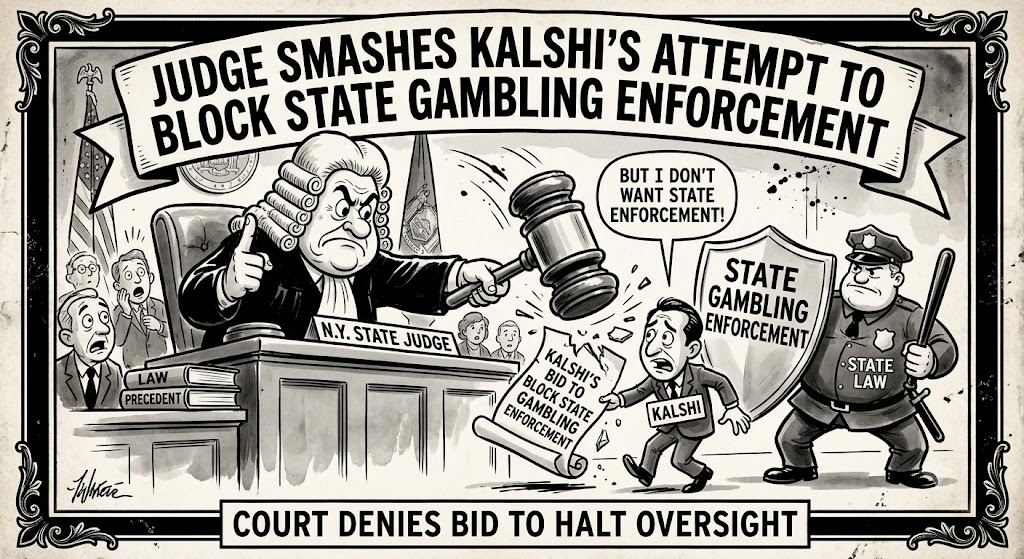
Kalshi loses New York
Background: the New York State Gaming Commission had moved to stop Kalshi from offering sports event contracts to New Yorkers, treating them as unlicensed sports betting. Kalshi sued and asked the court for a preliminary injunction, an order that would have barred the Commission from enforcing state law against it while the case plays out. Its argument, as everywhere else, was that the Commodity Exchange Act gives the CFTC exclusive jurisdiction and preempts state gambling law.
On July 7, Judge Analisa Torres said no. Congress, she wrote, did not intend to “regulate so broadly as to exclude all state gambling laws from regulating transactions involving swaps.” Kalshi keeps operating for now, but it does so in its home state without legal protection, and the largest sports betting market in the country ($26B+ handle last year) is now genuinely at risk for it. Gaming lawyer Daniel Wallach called it a “major, major loss” with likely knock-on effects in Connecticut and the other New York federal suits.
Why this matters more than last week’s Michigan injunction: Michigan was a state court pausing Kalshi’s operations before the main legal question was decided. New York was a federal judge actually deciding that question, and deciding it against Kalshi.
The rest of the board
| Front | Status | Next date |
|---|---|---|
| New York | Injunction denied, CEA does not preempt | CFTC’s parallel NY suit pending |
| Nevada | State supreme court denied Kalshi’s stay July 1 | Contempt hearing July 16; 9th Cir. ruling ~July 15 |
| Michigan | TRO amended; Kalshi now geofencing the state | Court evaluating geofence compliance |
| Arizona | CFTC injunction blocks state criminal charges; both sides appealing | Arizona’s opening brief Aug 3 |
| Maryland (4th Cir.) | Ruling pending | Expected by July 30 |
| Minnesota | Ban signed into law | Effective Aug 1 |
| North Carolina | Gov. Stein signed a 6% tax on PM net trading fee revenue | In effect via state budget |
North Carolina is the one to file away. A second camp of states is emerging that would rather tax prediction markets than fight them:
| State | Tax | Status |
|---|---|---|
| Kentucky | 14.25% excise on transaction fees | Enacted April 2026 (while the AG still sues Kalshi separately) |
| Illinois | Tiered transaction tax, folded into the sports wagering regime with licensing | Enacted; Kalshi sued in June to block it |
| North Carolina | 6% on net trading fee revenue from NC residents | Signed; effective Jan 1, 2027 |
| New Jersey | 9% surtax | Bills advanced, pending |
North Carolina went furthest: its statute explicitly recognizes the CFTC’s “exclusive federal regulatory authority,” making it the first state to side with federal preemption while collecting revenue. And the rate design is the tell. NC sportsbooks pay 23% while prediction markets pay 6%, so a taxed-and-tolerated PM still holds a big cost advantage over the licensed book next door. Every state that taxes prediction markets implicitly legitimizes them, which cuts against the AGs suing to shut them down. The industry noticed too: the Coalition for Prediction Markets just hired former CFTC commissioner Brian Quintenz as senior advisor.
Nevada: the Gaming Control Board asked the court to hold Kalshi in contempt for violating the May 18 order, and the July 16 hearing decides it. If Kalshi is held in contempt, that’s the first time a prediction market faces sanctions rather than just an order to stop. Separately, Nevada’s US senators (Rosen and Cortez Masto) are pushing to protect state oversight of prediction markets at the federal level. The incumbents put numbers on it. Nevada sports wagering is down $249M year to date, about 7% of the ~$3.5B wagered in the same five months last year, with April the worst month at -15%.
Color from the week. Kalshi’s lifetime trading volume passed $100B, with a new daily record during the World Cup. Bloomberg reported (July 6) that the only people consistently making money on Kalshi and Polymarket are professional market makers, and a class action filed in the same New York court accuses Kalshi of collecting sensitive personal data from users.
Burry’s Big bet: Michael Burry publicly backed sportsbooks on X to survive the prediction market threat.
So what? Kalshi’s $40B valuation assumes its federal preemption theory wins. This week a federal judge in its home city said the theory is wrong, and two more appellate rulings land within three weeks. If the 9th Circuit sides with Nevada, there is a confirmed circuit split and this goes to the Supreme Court with momentum running against Kalshi. Watch July 15, 16, and 30.
THE ORIENT
Macau & Asia
July is soft on weak demand. After June’s 12% decline, the sell side converged on a weak July: Citi models roughly MOP21.0B (down 5% YoY), Seaport sees down 7-9%, Deutsche Bank down 7.9%. All three attribute the softness to the World Cup and expect the daily run-rate to recover after the July 19 final, helped by a heavy concert calendar. Morgan Stanley cut its 2026 GGR estimate to ~MOP260.6B.
Q2 market share. Seaport estimates Sands China gave back about 200bps of share in Q2, with Melco also losing ground, while Wynn and MGM posted the biggest gains.
Context matters here: Sands had gained the most share of any operator in Q1, JP Morgan credited to record Londoner contribution and stepped-up promotional spend. Q2 looks like the give-back, as competitors matched reinvestment and Sands’ promo-led gains normalized.
Korea: record revenue, 52-week-low stocks. The foreigner-only casino names all hit 12-month lows this month even as revenues run at all-time highs and inbound tourism keeps surging: Paradise Co at KRW12,220 and Grand Korea Leisure at KRW10,150 on July 3, Lotte Tour (Jeju Dream Tower) in late June. When stocks make new lows against record fundamentals, the market is pricing something structural, most plausibly the Chinese VIP concentration risk and the same money-flow scrutiny weighing on Macau.
So what? The World Cup explanation gets tested the moment the tournament ends. If the daily rate doesn’t recover toward Citi’s MOP677M in late July, this is a demand problem and 2H consensus comes down further.
THE OLD WORLD
Europe + Canada
UK costs keep stacking. The government confirmed the 25% license fee increase will land in full on October 1, rejecting the phased introduction operators lobbied for. That sits on top of the 40% remote gaming duty from April.
Flutter is cutting costs in response to the UK tax increase, most visibly at PokerStars, which reduced headcount across Europe, Canada and the UK this week.
France: land-based consolidation. Banijay Gaming, the standalone gambling division that already houses Betclic and Tipico, agreed to acquire Groupe JOA and its 33 French casinos from Blackstone and Kings Park Capital, with completion expected in 2H26 pending regulatory approvals. That assembles a French champion spanning retail casinos and online betting in one platform, and it puts a second consolidator on FDJ’s home turf just as FDJ digests Unibet. European gaming M&A is running hotter than the sector’s stock prices suggest.
Spain goes after the prediction markets. The Spanish regulator opened disciplinary proceedings against Kalshi and Polymarket, citing insufficient identity verification and risk to minors, and signed a joint initiative with several other countries to share information and track prediction market activity. This is the first coordinated European enforcement move against the PM platforms, and it opens a second continent of legal exposure while the US fights are still running.
So what? The August prints from Flutter and Entain are the first real evidence of whether cost cuts are holding UK margins, or whether customers are leaking to offshore sites offering better odds.
THE LOCAL
US Regional Gaming & Deal Watch
Caesars: an 11th-hour bid, and a quiet exit that says more. Quick recap of the setup: Icahn built his Caesars stake to force a sale and unlock value, and in late May the board agreed to Tilman Fertitta’s $17.6B all-cash take-private at $31/share (a 49% premium to the unaffected February price; Fertitta assumes $11.9B of debt), with a go-shop window through July 11. This week gave us real drama. Icahn surfaced a $33/share rival bid, with Bloomberg reporting Jefferies was sounding out investors on ~$5B of debt to fund it.
Yet the market isn’t buying it: Caesars closed Wednesday at $29.82, below both offers, and reports cited by Howard Stutz say the Icahn bid is unlikely to prevail. Then on July 10, Courtney Mather, the Vision One CEO who ran money at Icahn Enterprises and has sat on Caesars’ board since 2019, quietly resigned; no press release, profile simply removed. That’s the tell worth weighting. Icahn’s man leaving the board as the go-shop closes reads like the sale Icahn agitated for is getting done, with the $33 headline serving as a last squeeze on price rather than a serious attempt to own the company.
Meanwhile Fertitta’s team gave Nevada regulators the full deal map on July 8, and it’s worth keeping: HSR antitrust filing lands July 13, gaming applications in the long-lead jurisdictions were due by July 10 with the rest within 45 days, and they estimate nine to ten months of regulatory approvals plus an SEC-reviewed proxy and shareholder vote before closing.
One more nugget: Fertitta is keeping his 12.7% Wynn stake as a passive investment, so post-close he’d own Caesars outright and remain Wynn’s largest shareholder.
The locals backdrop is softening. Las Vegas unemployment improved to 5.3% in May (from 5.8% in January) with 25,800 jobs added since the start of the year, but that’s still the third-highest rate among big US metros. Bad read for LV locals stocks.
Elsewhere. Genting Americas raised a new $2B bank facility to refinance debt and fund the second phase of Resorts World NYC, real capital behind the only downstate license actually operating.
So what? Caesars trading below both bids tells you the market is pricing deal timeline risk (nine-plus months of approvals) rather than doubting a deal happens.
THE PROJECTS
Global Greenfield & Development Watch
- Wynn Al Marjan (UAE). Construction is at the final two floors, on target for a Q1 2027 opening.
- MGM Osaka. Two supplier-side signals this week. Konami became the first manufacturer to file license applications with the Japan Casino Regulatory Commission, and the first to file across every applicable category. And Osaka opened its RFP for Phase 2 non-gaming development around the IR site. Konami moving first matters beyond bragging rights: Japan’s machine makers built their businesses on pachinko and pachislot, a market in long structural decline, and the regulated casino floor at MGM Osaka is the domestic pivot opportunity. Whoever gets licensed first shapes the supplier lineup for 2030, and it pressures Sega Sammy, Universal and the rest of the pachinko complex to follow or cede the new channel.
So what? Wynn currently has the cleanest story in the sector: Q2 Macau share gains, a nine-month runway to Al Marjan.
OTHER
Sweepstakes & Skill Games
Two related but distinct gray markets, both under pressure this week. Sweepstakes casinos are online: they sell “gold coins” for entertainment play and bundle in “sweep coins” redeemable for cash, a structure designed to avoid state gambling licenses. Skill games are physical: slot-style cash machines in bars, convenience stores and clubs whose makers argue a token skill element (spotting a pattern before spinning, for instance) exempts them from slot machine laws. Different products, same regulatory question: unlicensed, untaxed gambling.
Sweepstakes: bans going live. Indiana and Iowa’s bans took effect July 1. VGW pulled every brand from Indiana (Chumba, LuckyLand, Global Poker), alongside Stake.us, McLuck, Hello Millions and High 5. Six states have enacted bans in 2026: California, Indiana, Maine, New York, Louisiana and Tennessee.
Enforcement is the real question, and the earlier movers show how it escalates. Michigan’s gaming board has issued cease-and-desist orders since 2024, and Michigan and Arizona together sent more than 100 of them in 2025. New York’s law, signed last December, carries fines of $10,000 to $100,000 per violation and extends liability to payment processors, geolocation vendors and marketing affiliates; operators exited within weeks. That last part is the effective design: you don’t have to catch the offshore operator if their payment rails won’t touch them. Indiana looks early-stage by comparison, with tracking showing dozens of platforms still accepting Indiana players on July 2. Expect the C&D wave and processor pressure to follow.
Skill games: Pennsylvania’s four-month clock. The PA Supreme Court ruled in June that skill games are slot machines under state law, but stayed enforcement for 120 days, giving the legislature until roughly October to regulate them. The fight is now purely about the tax rate:
| Proposal | Rate |
|---|---|
| Gov. Shapiro (D) | 52% of revenue, matching casino slots; ~$800M year-one projection |
| Senate GOP | 35% or 16% competing bills |
| Bipartisan alternative | $500 flat fee per machine per month |
So what? Both gray markets are being pushed onto the same fork: get taxed and regulated, or get banned. Either branch helps licensed operators. For Pennsylvania specifically, a rate near 52% erases the machines’ economic edge over casino slots; a rate near 16% entrenches it. High 5 Games is the name to watch, since it operates sweepstakes while holding licensed supplier status, an increasingly awkward combination.
THE SHIFT
Moves & Shakers
- Caesars: Courtney Mather (Vision One CEO, ex-Icahn Enterprises portfolio manager) resigned from the board after seven years, as the Fertitta go-shop window closed. See THE LOCAL for why this reads as a positive.
- DICJ (Macau gaming regulator): Lio Chi Chong, the deputy director, is serving as Acting Director after Ng Wai Han’s promotion to Secretary of Economy and Finance. Worth watching who gets the permanent seat; the DICJ director sets the tone on concession compliance.
- Coalition for Prediction Markets: former CFTC commissioner Brian Quintenz joins as senior advisor.
THE NUMBER
52% is Shapiro’s proposed tax on Pennsylvania skill-game revenue, worth ~$800M in year one by his administration’s math. Where the legislature lands between 16% and 52% by October decides whether the gray-machine economy survives in its biggest state.
THE CALENDAR
| Date | Event |
|---|---|
| July 11 | Caesars go-shop window closed (watch for confirmation Fertitta deal proceeds) |
| July 13 | Fertitta files HSR antitrust application for Caesars deal |
| ~July 15 | 9th Circuit ruling expected, Kalshi v. Nevada |
| July 16 | Nevada contempt hearing (Kalshi) |
| July 19 | World Cup final; Macau’s clean demand read begins |
| July 29 | MGM Q2 earnings (first forced disclosure point on the Diller offer) |
| ~July 30 | 4th Circuit ruling expected, Kalshi v. Maryland |
| July 31 / Aug 3 | Flutter’s last LSE trading day / delisting |
| Aug 1 | Minnesota prediction market ban effective |
| Early Aug | Flutter Q2 update; Bally’s LVCVA financing deadline |
| Aug 13 | Entain interims |
Leave a Reply